


If you have received an agency SEO audit recently, there is a reasonable chance meta descriptions appear somewhere on the list of issues. Missing. Duplicated. Over 155 characters. The tool has flagged them, the report has counted them, and now someone is deciding how long it will take to fix them all.
The only approach to consider depends on which pages you are looking at, and what you are actually trying to achieve.
Key takeaways
- Meta descriptions are not a ranking factor and never have been. Fixing them will not directly influence your position in search results.
- Google replaces the description you write around two thirds of the time, choosing page content it judges a better match for the query.
- The real opportunity is click-through rate. Your description is the one element you control at the moment someone is choosing between your result and others.
- For product and category pages in competitive categories, getting the description right is a marginal gain worth making. For most other page types, being descriptive is enough.
- At scale, a programmatic template approach is the only realistic way to handle thousands of pages without the task consuming resource disproportionate to its return.
Why meta descriptions keep showing up in your audit (and what that actually means)
Tools like Screaming Frog are good at surfacing structural problems. They will catch missing descriptions, duplicates, anything over 155 characters, anything under 70, pixel-length outliers, and placement errors like multiple meta tags or descriptions sitting outside the head element.
What they cannot tell you is whether any of that is actually hurting anything. The output is a list of flags, not a priority order. And for meta descriptions specifically, that distinction matters more than it does for most other items on the same report.
The fact that a page is missing a meta description does not mean Google is showing something terrible in its place. It means Google will choose what to show, and it will make that choice again for every query the page appears against. Which leads to the more useful question.
They’re not a ranking factor, but still worth getting right
Meta descriptions have never been a ranking signal at Google. Matt Cutts confirmed it in 2009, and John Mueller has restated it since. They do not influence where your page appears. What they do influence is whether someone clicks your result once it appears, and that is a different problem with a different solution.
They also will not appear as often as you expect. Ahrefs found Google rewrote the description on 62.78% of results across 20,000 keywords, and Portent put the figure above 70%.
Both studies are desktop-only and a few years old, but it has held – write a description and Google will show something else roughly two thirds of the time.
When you do not write one at all, Google generates a snippet from the page, selecting the content it judges best relates to that specific query. That process is algorithmic rather than editorial. It picks from what is on the page, which means it can only work with what you have given it a header, a navigation element, the first coherent block of copy. For pages with thin body content, the result is often incoherent.
Click-through rate is becoming harder to earn as SERPs change. The meta description is the one element you control in that moment of comparison, which makes it worth getting right for the pages that matter most, even though it carries no direct ranking weight.
Pew Research found that users who saw a Google AI summary clicked a traditional search result 8% of the time, against 15% when no AI summary appeared.
Fewer clicks are available on a lot of queries than were available two years ago. That is not an argument for ignoring descriptions. It is an argument for spending the effort only where clicks are still genuinely winnable, which is the position this piece takes throughout.
The e-commerce meta descriptions worth your time are the ones where your result is already appearing and you are losing the click to a competitor because your description gives the searcher no reason to choose you.
Homepage meta descriptions
The homepage is usually the worst offender, and the reason is straightforward. Homepages carry little body copy compared to other page types. When Google generates a snippet, it has almost nothing useful to work with, so it reaches for whatever text it can find: navigation labels, footer links, header fragments, or stray promotional copy from a banner.
The result might be something like “New Arrivals | Sale | About Us | Contact” surfaced as the summary of your brand for someone who has never heard of you.
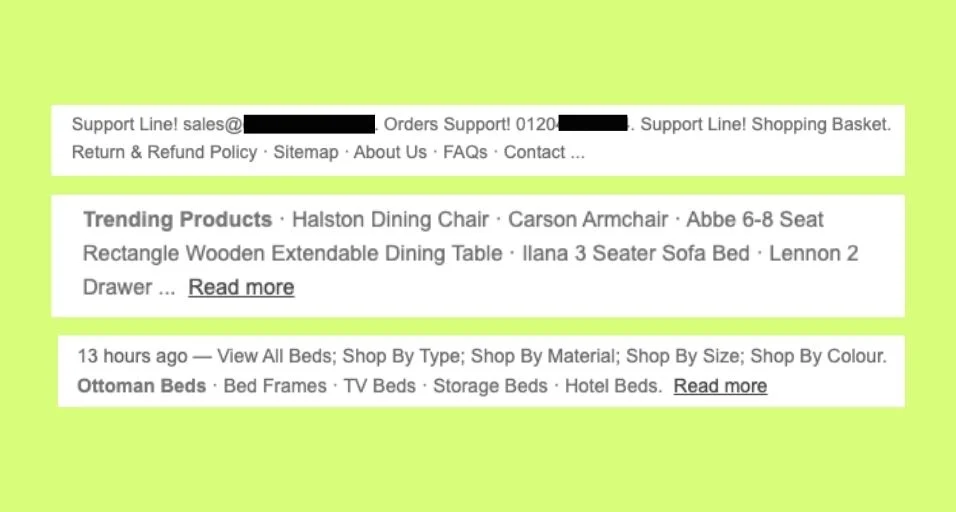
A manually written homepage meta description is the chance to tell that person, in joined-up sentences, what your store sells and why it is worth clicking. Cover the product ranges and categories you carry, and give some indication of why your store is the right one. Not a keyword list. Not a slogan. A coherent description of what someone will find when they arrive.
This is one of the few page types where writing the description yourself is almost always better than leaving it to auto-generation, because the gap between what Google pulls and what you would write is usually significant. It matters most on non-brand queries, where the searcher does not already know who you are.
Product page descriptions
When someone searches for a specific product and your page appears, Google will usually bold words in the snippet that match their query, along with close variants of those words. For product pages, that bolding is what makes the description useful.
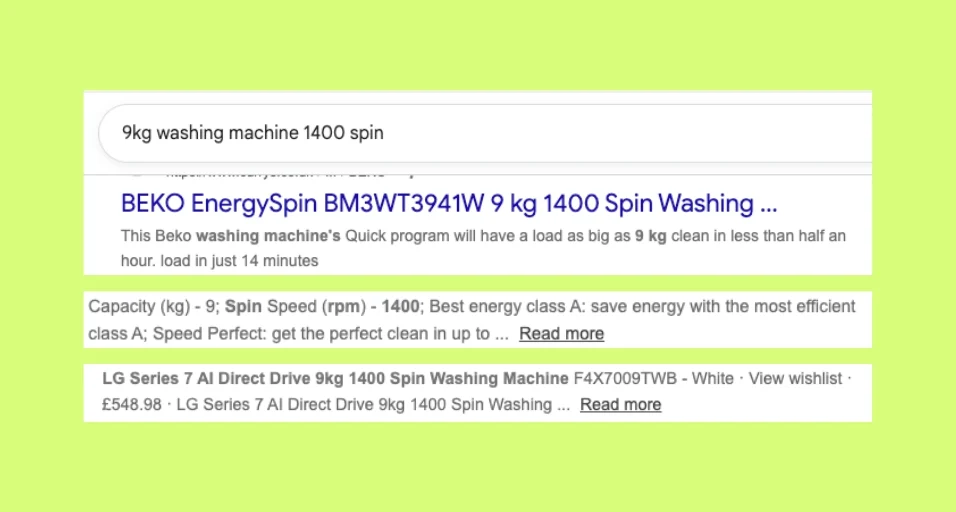
The obvious tension is Google is also rewriting most descriptions, so the bolding often applies to text Google chose rather than text you wrote. Both things are true, and they point at the same tactic. If the size, colour or model code a customer is searching for appears in your description, you improve the odds twice over. Google has less reason to replace a description that already contains the query terms, and if it does replace it, it is pulling from a page you have made sure carries those attributes anyway.
Get it right and your result looks more relevant at a glance than a competitor’s generic copy. That is not a ranking signal. It is a click signal at the exact moment someone is comparing results.
Layer in your USPs alongside those product attributes: free delivery, dispatch time, warranty terms, anything that applies specifically to this product and that a potential buyer would want to know before clicking. These are things most people are not searching for, but they are reasons to choose you over the result above or below.
The caveat with product pages is volume. Most e-commerce stores have thousands of them, and the programmatic approach covered below is the only feasible way to handle that without the work consuming resource far beyond its likely return.
Category and collection pages
Category pages typically target the highest-volume searches in your category. Someone looking for washing machines, sofas or running shoes is still in the process of narrowing down, which means the description has a slightly different job than it does on a product page.
Include the primary category term and genuinely related variants. If you sell washing machines, you might also mention freestanding models, integrated options or washer-dryers, because those terms can be bolded when a searcher’s query includes them. This is not about stacking synonyms together; it is about including terms that are genuinely different and that different searchers might use.
Use the remaining space for the selling point. What makes your range the one to click through to? The collection page meta description is the moment to put that across, briefly and clearly, before the customer decides whether your result is worth their time.
For more on getting the title tag right alongside the description on these pages, the companion piece on title tags for e-commerce stores covers where that effort sits in the priority order.
Other page types
For informational pages, the job is simple. Describe what is on the page in a way that matches why someone is finding it. If your about page is ranking for something, competition on that term is probably low enough that your position is not at risk regardless of what the description says.
FAQ and blog pages follow the same logic. Write a description that accurately summarises what the reader will find. Do not engineer anything. If the content is useful and specific, the description just needs to reflect that honestly. Over-thinking these pages is a distraction from the pages where the margin actually matters.
How to approach meta descriptions at scale
Most established e-commerce stores have thousands of pages. Writing individual descriptions for each one is not realistic, and for the majority of product pages the return would not justify the time.
James Mechan, Strategy & Delivery Director at WE-COM, has 14 years in SEO and describes the approach that he has seen in practice:
“The only realistic way to handle this at scale is to build a template system. A structured formula with an intro drawn from the product or category data, the core product or category information, and a call to action that rotates. For most stores, that work belongs in the ten percent of improvements that, combined with others, can make a difference rather than at the top of the to-do list.”
That template approach is worth building once and maintaining. Magento supports dynamic templates natively, through Product Fields Auto-Generation, using masks such as {{name}} and {{sku}}. It needs careful setup, the configuration is global rather than store-view scope, and it does not reliably populate on products created through the API, so descriptions can end up technically present and practically useless.
Shopify works differently. There is a meta description field you can set per product, collection or page, but when you leave it empty most themes render no meta description tag at all, because the standard Liquid pattern wraps it in a condition. There is no platform-level fallback to your product copy. Google fills the gap instead, and any fallback you want has to be built into the theme. The risk with any template system is the same. If the underlying product or category data is inconsistent, the output will reflect that.
On the more specific end of what is possible, we have implemented a dynamic asset count inside category page descriptions for a music licensing client, surfacing the number of tracks or sounds available on each category page directly in the description. The intent was to give searchers a clearer sense of depth and specificity before they clicked. No confirmed performance benefit was observed, but the descriptions became materially more informative, which is the honest framing for what dynamic data can achieve.
If you do invest time in meta descriptions, Google Search Console is the right place to measure the effect. Isolate the pages you are changing, record baseline clicks, impressions and click-through rate before you make the changes, then allow enough time for the new descriptions to be indexed and reflected in the data before you compare. Without that isolation, any change will be invisible in aggregate performance figures.
FAQ
Does Google always use my meta description?
No. Google rewrites or replaces descriptions whenever it judges that content pulled from the page better fits the query, and the studies above put that at somewhere between 60% and 70% of results. Google’s own guidance makes clear that it generates snippets dynamically, which means even a well-written description may not appear in every context.
How long should a meta description be for a product page?
The commonly cited range of 150 to 155 characters is a tool threshold, not a performance target. Google specifies no character limit and truncates to fit the device width, which is closer to 120 characters on mobile. Write the description to say what it needs to say for that product, and front-load the part that matters. If it lands around that length naturally, fine. Cutting useful information to hit a character count is the wrong trade-off.
Can I use the same meta description across multiple product pages?
Technically yes, practically no. Duplicate descriptions across product pages mean every result looks identical to a searcher comparing multiple results from your store, which removes any advantage the description could provide. The programmatic template approach avoids duplication without requiring a unique copy for every page individually.