






AI has been dominating SEO conversations for the past 12 to 18 months, and there are no signs of it slowing down.
For in-house e-commerce teams, this surge of AI chatter can easily shape priorities, create distractions, and make planning for 2026 and beyond feel overwhelming.
Some of what you hear is grounded in research. Some is pure speculation. And a lot is a messy combination of both.
It leads to confusion about where to start, what to ignore, and what actually matters for real, day-to-day performance.
We’ve intentionally stayed quiet on this publicly – not because we’re behind, and not because we don’t have an opinion. This year, we’ve had countless conversations and even training sessions with clients and partners to help them navigate all of this.
But the last thing the industry needs is more hype, noise, or untested claims.
That’s why we’ve written this post: to cut through the clutter and share what we believe in-house teams need to know right now.
AI and search are moving fast, and some of the specifics may evolve quickly – but the core principles we outline here are unlikely to change and can be acted on immediately.
Reading this post will give you and your team a grounded, actionable perspective amid all the industry hype.
We’re offering e-commerce retailers a free AI SEO Risks + Rewards Report to understand how this could all impact your performance and sector.
This is completely bespoke to your business, and the output of a manual process with several different tools, to give you real answers and actions.
We’re also providing a limited number of dedicated training sessions for in-house teams to give you the full lowdown on AI and SEO.
Click the images below to find out more:

But make sure to read on as we answer the important questions you’ve likely got:
- What do people even mean?
- What’s with all the names?
- What is actually different?
- Why does it matter?
- What do you need to know?
What do people even mean?
Artificial Intelligence (AI) in search isn’t new.
Google has used machine learning for over a decade, from RankBrain (2015) and BERT (2018) to MUM (2021), in order to better understand queries, content, and intent.
But when people talk about “AI” today, they’re rarely referring to this. The most common talking point, and the use case creating the most confusion, is of course generative AI.
Generative AI is a type of artificial intelligence that can create new content, such as text, images, music, and code, by learning from and mimicking the patterns in large datasets.
These models learn complex patterns and structures from their training data, then when a user provides a prompt, the AI uses what it has learned to generate a new output.
Some of the most popular generative AI tools you’ve likely heard of and used include ChatGPT, Claude, Perplexity, Microsoft Copilot, and Google Gemini, as well as DALL·E and MidJourney for images. The text-based tools are built on large language models (LLMs), whilst the image tools use different types of generative AI models.
These are all really powerful and accessible, which is part of why they’ve captured so much attention and hype. They can generate at scale and fast, whether that’s e-commerce product descriptions, marketing copy, blog posts, or even image mock-ups and ads.
There is a lot to be said about the accuracy, quality, and uniqueness of these outputs when it comes to SEO, but we’ll leave that for another time.
You’ve also got AI being introduced into more and more tools and platforms, like Shopify, Magento, and other e-commerce tools. These companies often advertise “AI-powered” features or automation, like product recommendations or predictive search suggestions, and we’re no doubt still in the early stages of the value this could provide for users in the future.
All of this together could be classified as applied or operational AI, supporting workflows, powering features, or generating content.
There’s then AI in the realms of search engines and tools, particularly Google, which is an entirely different consideration.
This includes the algorithms that evaluate content, detect patterns, and measure usefulness, as well as how that information is displayed and provided in the actual results, directly impacting how much visibility and traffic your brand stands to get.
This is where we see the lines being blurred – between the AI tools and features your marketing team can use, and the AI systems that can influence your performance.
Are search engines like Google changing the rules? You might personally use tools like ChatGPT but do your customers? What’s the value of being cited and referenced in summaries? How will this really affect revenue for your business?
This is what we’ve tried to tackle for you here.
What’s with all the names?
We’ve been keeping a close eye on the debates (mostly on LinkedIn) between those in the industry about what this should all be called.
In case you’ve heard any of these new acronyms and terms, let me help you out:
SEO, which is of course Search Engine Optimisation, is the practice of optimising websites to appear higher in search results with the purpose of increasing organic traffic.
GEO, or Generative Engine Optimisation, focuses on being cited in AI-generated answers from Google and tools like ChatGPT.
AIO can be AI Optimisation, which means optimising with AI assistance in mind, or the abbreviation for AI Overviews (AIOs) in Google just to make it more confusing.
AEO stands for Answer Engine Optimisation, which is seemingly about performing well in AI-powered answer engines and voice or chat-based searches across different platforms.
LLMO, or Large Language Model Optimisation, is about increasing the likelihood of a brand or information being cited in AI-generated responses across platforms.
Spoiler alert, they’re all basically the same thing.
Buzzwords and acronyms that get thrown around to make this sound new or more complicated than it is – usually by people with an agenda or something to sell.
You could argue that goes for the term SEO too, which was made up by people working in the industry once upon a time, but regardless, it all comes down to the same core idea:
How do potential customers find your brand, content, and products online and how does that affect your business performance?
Although we don’t see a need for using these terms anytime soon or pushing a new “GEO” service to our clients, there are some differences to consider.
What is actually different?
If you break things down simply, for as long as search and SEO has existed there have essentially been the same two questions to answer:
1. What do I need to do to appear?
SEO can be complicated, so it’s long been simplified into talk around “factors” that your website and brand is evaluated against.
Back in the early days, this meant focusing on keywords, meta tags, and backlinks. Then it became about creating high-quality, relevant content based on intent and building authority.
In reality, there are hundreds of things to consider, but the principles for Google have been consistent for a number of years now, with each algorithm update essentially reinforcing this:
Is your business relevant, useful, and trustworthy enough to appear?
This will be no different tomorrow than it is today. The fundamentals remain the same, even as tools, algorithms, and AI capabilities change around us.
2. How prominently do I appear?
The days of ten blue links are long gone, despite some opinions that these recent developments are what’s ended them.
Search Engine Results Pages (SERPs) have continuously changed over the years, largely to keep up with user behaviour.
Things like featured snippets, local packs, video results, and shopping carousels have appeared in recent years. Not to forget mobile-first indexing that started to prioritise an entirely different device and SERP layout, as well as the ever-growing number of paid ads at the top of results – which look more and more like organic listings.
If this is all about how visible your brand is and where you appear, this shouldn’t be new – your strategy has always needed to consider not just ranking, but being seen in the right format, context, and places your target audience is looking.
The more notable change observed though has been AI Overviews, which started rolling out in UK results in August 2024. These are AI-generated summaries at the top of results pages that provide users with an answer or overview without requiring them to click through to a website.
More recently AI Mode was introduced by Google in July 2025, a separate tool within Google’s interface that uses generative AI to provide conversational, in-depth answers to complex questions instead of a list of links – a way to keep up with the likes of OpenAI and ChatGPT you could argue.
This represents a bigger potential behavioural shift. Instead of users scanning a results page, clicking into multiple sites, and comparing information themselves, AI Mode does the heavy lifting – summarising options, filtering choices, and even suggesting products based on criteria a user may not have explicitly stated.
How often AI Overviews appear in results, the usage of AI Mode or tools like ChatGPT, and how frequently and prominently your brand appears are what you should care about today.
Why does it matter?
This is a question far more SEOs and marketers should be asking themselves – and not enough are.
Data from Sparktoro in August 2025 found that 20% of Americans are now heavy users of AI tools, but 95% still use search engines every month – with 86% classed as heavy search users.
Importantly, the data also shows that when people adopt AI tools, their Google searches don’t decline – they actually increase.
This data is likely to be reflected globally and it shows changes to how search engines are used, when they are used, and what users expect from it – not “killing” or replacing them.
You then have to look at the usage numbers for the important context.
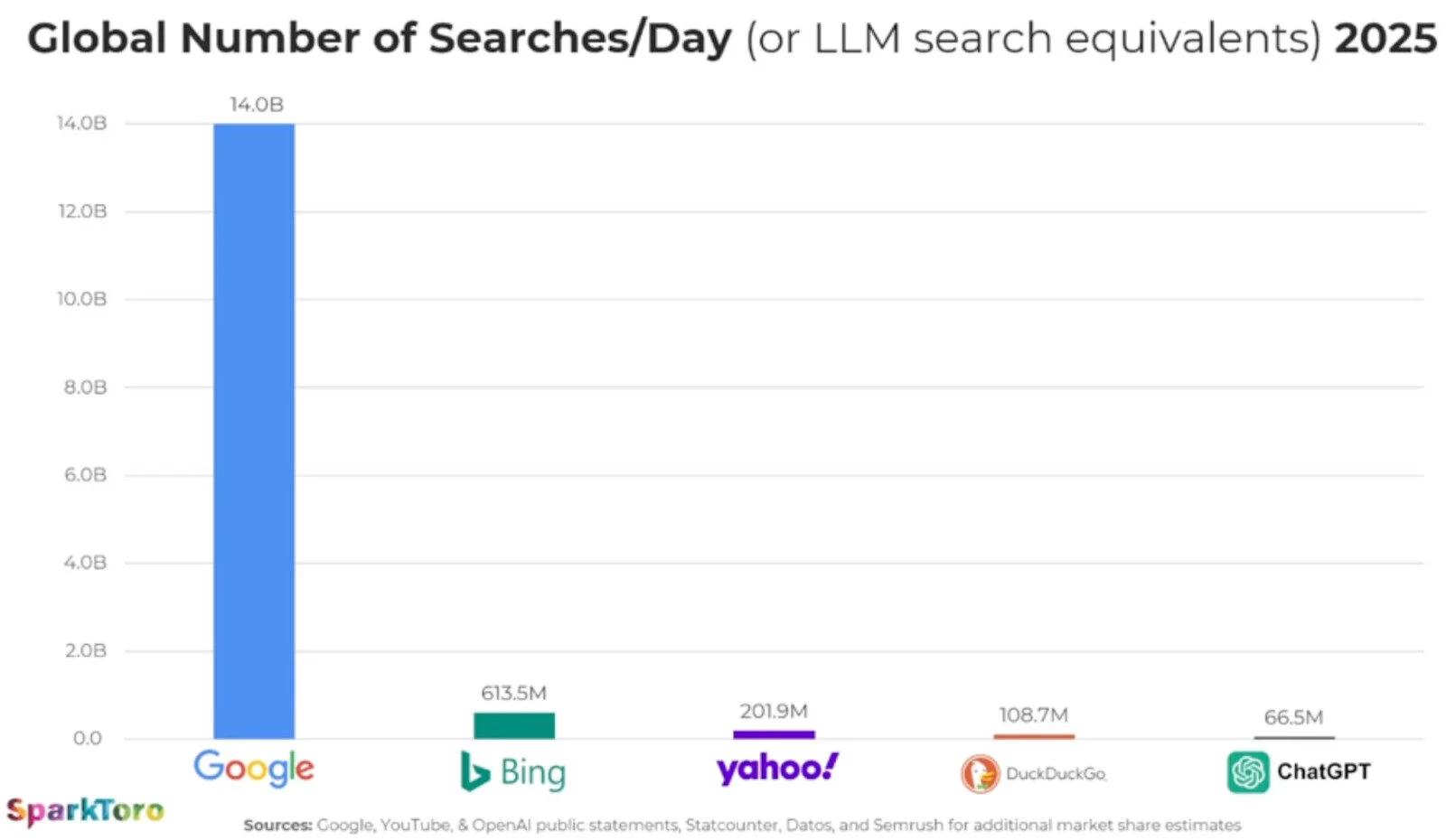
ChatGPT now processes 66 million “search-like” prompts per day, while Google still processes about 14 billion searches daily – roughly 210 times more.
Bing has always been a bit of a punchbag for SEOs, and many consultants (including myself) will have advised businesses to focus on doing the right things for Google and trust that this will translate into success within Bing.
Yet, the industry is obsessing over a tool that’s nine times smaller than even Bing.
And when you look at how often users click through to brands cited in AI summaries, AI-driven search referrals accounted for less than 1% of traffic from January to August this year – with near-zero direct conversions tracked (BrightEdge).
AI search functions as a research and discovery channel, not for conversions. Potential customers are not there yet, despite the technology, and there’s no way to predict when or how quickly this will increase in future.
What has been changing for a long time, and is now at a point of being understood more, is how users behave:
- They’re asking different types of questions.
- They expect more context, comparison, and guidance upfront.
- They’re doing more research before landing on a website.
- They’re using tools to filter options, validate choices, or summarise.
- They often enter the buying journey earlier or later than before.
This doesn’t remove the need to appear in search engines.
It changes how you adapt to the way customers discover, evaluate, and choose brands – and how visible you need to be across multiple touch points, not just “traditional” rankings.
What do you need to know?
Understanding how AI is affecting search and SEO doesn’t mean starting from scratch.
The core principles that have guided effective SEO for years still apply and are more relevant than ever, but the way to look at them is different.
Here are ten areas that the industry is researching, testing, or talking about, and we feel every e-commerce team should know today:
1. The foundations haven’t changed
AI-powered search actually relies on the same underlying indexes as Google and other search engines, but the way queries are processed and results are presented is different.
Rather than returning a list of results, AI tools like ChatGPT, Claude, and Perplexity analyse multiple sources (including those performing well in Google) to generate summaries or conversational answers.
For brands, this means no longer just competing for a ranking position to “own” above others.
It’s competing to be recognised, summarised, and cited as a trusted source of information, usually directly alongside competitor brands and websites.
The more prominent or visible you are, the better, as AI is believed to rely on consensus across multiple sources.
2. AI Overviews aren’t always there
Not every search will generate or trigger an AI Overview in Google.
These summaries are most commonly shown for informational or research-type queries where users are looking for answers, context, or comparisons.
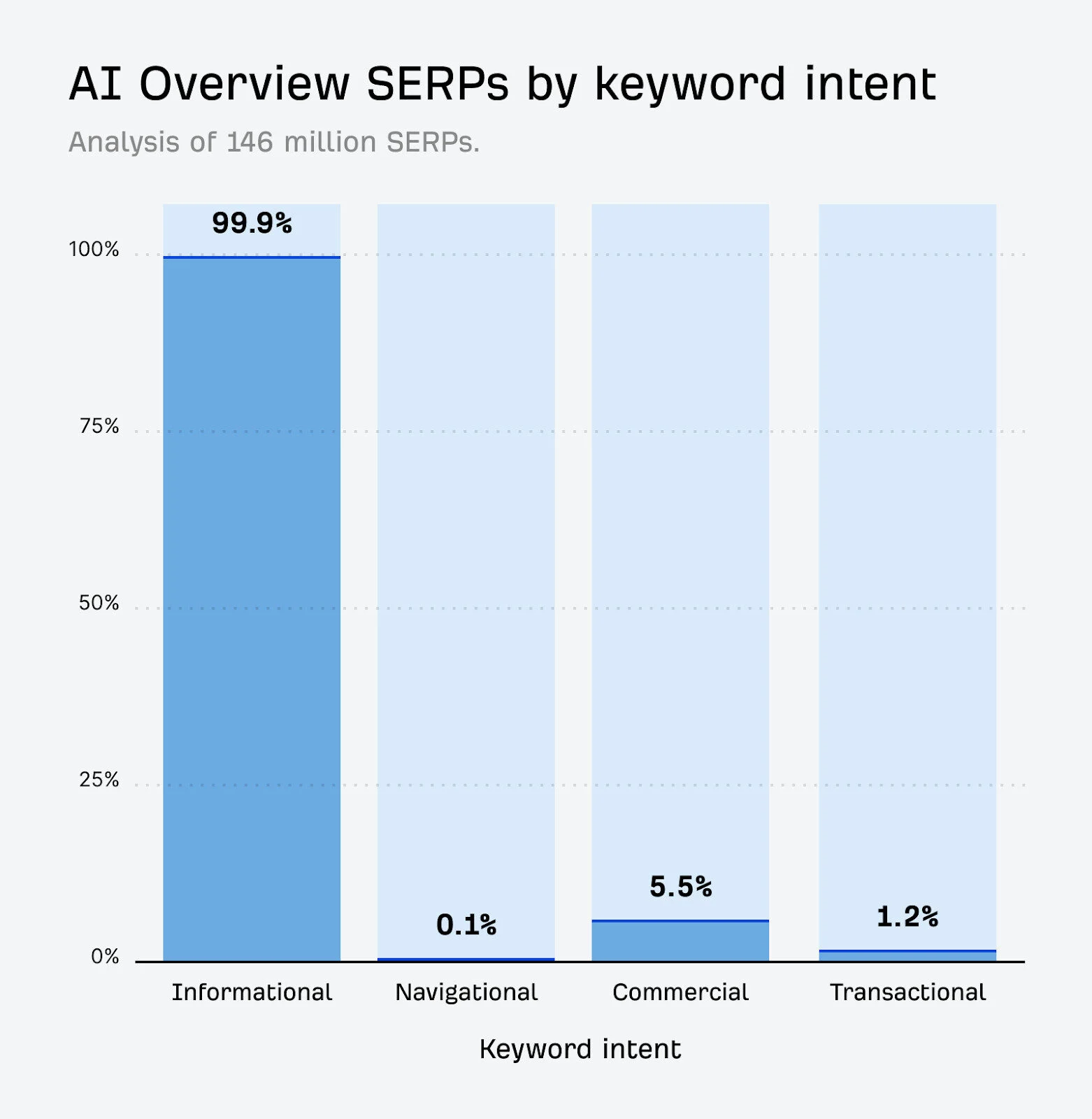
Based on a recent Ahrefs study of 146 million SERPs, AIOs appeared on 99.9% of searches with informational intent.
Transactional queries, for example “buy running shoes size 9”, will still show the usual SERPs with shopping carousels, or paid ads. Some high-risk or regulated categories may also suppress AIOs for safety reasons.
Understanding which of your target queries are likely to trigger an AI Overview is critical for mapping out where your content could be surfaced and how performance might change.
Certain sectors (like Health and Pets) are no doubt going to be affected more than others, as the lines between informational and commercial intent are blurred. Keeping track of the topics that are being summarised will help prioritise and stay ahead of competitors.
3. Search intent should (already) be the focus
Even with AI in the mix, the fundamental question of search remains: what is this person trying to achieve?
Whether someone is learning something new, comparing options, or ready to make a purchase, AI-generated summaries are designed to reflect the underlying intent – not the literal queries (keywords) used.
The challenge is ensuring that your content satisfies these varied intents clearly enough that even when it’s condensed into a short summary or conversational answer, the correct message still comes through.
Intent often shifts throughout a journey, and AI tools can smooth out those shifts automatically. That means gaps or misalignment in your content become more visible, so if your product page doesn’t answer a comparison question, for example, AI will simply choose a competitor that does.
Understanding the full journey around a query (not just the keyword itself) is essential. This has been true for years, but AI has made its importance impossible to ignore.
4. Trust and credibility are amplified
AI models tend to prioritise sources that are accurate, authoritative, and reliable, whilst poorly sourced or misleading content is unlikely to be cited.
Google’s search quality rater guidelines including E-E-A-T (Experience, Expertise, Authoritativeness, and Trustworthiness) play a significant role here, and similar principles influence how AI systems evaluate content.
If a model is going to summarise or rely on your information, it needs to be confident that what you say is correct, consistent, and backed by evidence.
For e-commerce, this shows up in the details, such as clear product information, transparent pricing, accurate specifications, credible reviews, unique photography, supporting guides, and proof that the business behind the pages actually exists and knows the category.
Even small lapses, such as broken links, thin content, unclear information, or outdated data, could reduce the likelihood of being cited. AI models tend to avoid ambiguity, so if they’re unsure, they may simply choose another source.
5. Content structure means clarity
There’s a narrative being pushed by some people within the industry about a new approach to content for AI called “chunking”.
It’s another buzzword that basically means breaking text into smaller, digestible pieces so large language models can understand, summarise, and cite it easily.
In reality, this is just good practice.
Clear headings, logical sub-sections, bullet points, and tables have always made content easier for users and search engines to scan.
What’s changed is the extent to which structure affects how your content is represented elsewhere. Well-organised content helps AI models identify key claims, extract the most relevant parts, and accurately attribute information.
Good structure makes your content easy for humans and machines to understand, which increases your chances of being surfaced, cited, and trusted.
6. Build authority around topics
Search engines and AI systems prefer sources that demonstrate depth and breadth on a subject rather than isolated pages with a single answer.
The old-school approach to SEO is picking individual keywords, assigning each one a page, and publishing content that aims to rank for them. This worked best when Google’s ranking signals were more literal (string matching etc.), but not as much in recent years.
Although not a new term, “Topical Authority” is being spoken about more and more. In short, it means building comprehensive interlinked content around key themes that signal expertise and make it more likely your brand will be cited.
While one-off pieces of content can still generate traffic, sustained coverage across topics is increasingly what Google and AI systems “reward” – for example, a series of pages, buying guides, and FAQs that comprehensively cover a single product area.
7. Originality will come out on top
Topical authority isn’t just about covering a subject repeatedly – it’s not necessarily a volume game.
It’s about adding unique, valuable information that isn’t already well-represented or available on the web – currently being referred to by some people as “information gain” with AI.
Whether that’s proprietary data, unique methodologies, or user research, the more your content contributes new insights, actionable advice, or data, the more likely it is to be cited by AI systems and considered authoritative by search engines.
In other words, don’t just repeat what’s out there or rely on models trained on existing information. Become the source that teaches, informs, or quantifies something new.
8. Keep content fresh and accurate
AI summaries will no doubt favour sources that are current and factually accurate. Regularly updating content, correcting errors, and reflecting new trends or products increases the chances of being cited.
This is particularly important in industries with fast-changing inventory, seasonal shifts, or regulatory updates. A static page risks being ignored, even if it once ranked well.
Freshness also matters because many AI systems incorporate a “recency bias,” giving slightly more weight to up-to-date content when multiple sources present similar information.
Including updated data points, timestamps, and references signals that your content is trustworthy today – not last year. Stale or outdated pages, by contrast, are more likely to be excluded altogether.
9. Authority exists beyond backlinks
Backlinks matter, but AI is starting to evaluate authority in broader ways. Signals like user engagement, brand mentions, social proof, and repeated citations across trusted sources all likely contribute to the perception of authority.
AI systems look across the wider ecosystem, such as review sites, forums, social content, buying guides, expert articles, and other third-party mentions, to determine which brands are consistently referenced and trusted.
Brands with a consistent footprint across these will likely gain more visibility, not just within Google but in AI summaries too.
In other words, authority isn’t just what links you earn. It’s the overall presence, recognition, and trust your brand builds across the places your customers already spend time.
10. Structured data provides context
Structured data and Schema markup help search engines and AI understand the context of your pages more accurately.
Correctly implemented Schema can provide additional product details, reviews, FAQs, delivery information, and pricing in a way that makes summarisation more precise.
For e-commerce, this increases the likelihood of product pages, category pages, and other informational pages being included in AI-generated summaries – not just “traditional” search results.
Structured data also strengthens entity-level understanding (people, products, brands, categories etc.), which is becoming increasingly important in AI-driven discovery.
Good structured data doesn’t guarantee inclusion, but it ensures AI systems fully understand what your page offers, reducing ambiguity and improving how your content is interpreted and surfaced.
Taking the first step
Our best advice as a first step is simple – focus on the fundamentals, the only thing that actually matters today.
Prioritise clarity, authority, originality, and relevance in everything you do, and your team can act confidently rather than react to hype.
Consistently building and maintaining these foundations will mean your brand is well-positioned to navigate whatever changes AI or search engines bring next.
But start now. Every action you take today will compound over time, keeping your brand visible, trusted, and ahead of the curve across search and discovery platforms.
Feel free to get in touch if you have questions, and make sure to take advantage of our free report or training sessions whilst you can!
