


Our survey results about how experienced freelance specialists find and win new client work in 2026.
We carried out the survey between May and June 2026 and had 35 responses from marketing freelancers across the UK.
Our aim was to see what’s working, what isn’t, and what’s missing, to get visibility on the challenges freelancers face and help validate a new service idea for our agency.
Open text responses have been summarised using Gemini for Workspace, and given a percentage of how common each theme was. Percentages on multi-select questions add up to more than 100%, since respondents could choose more than one answer.
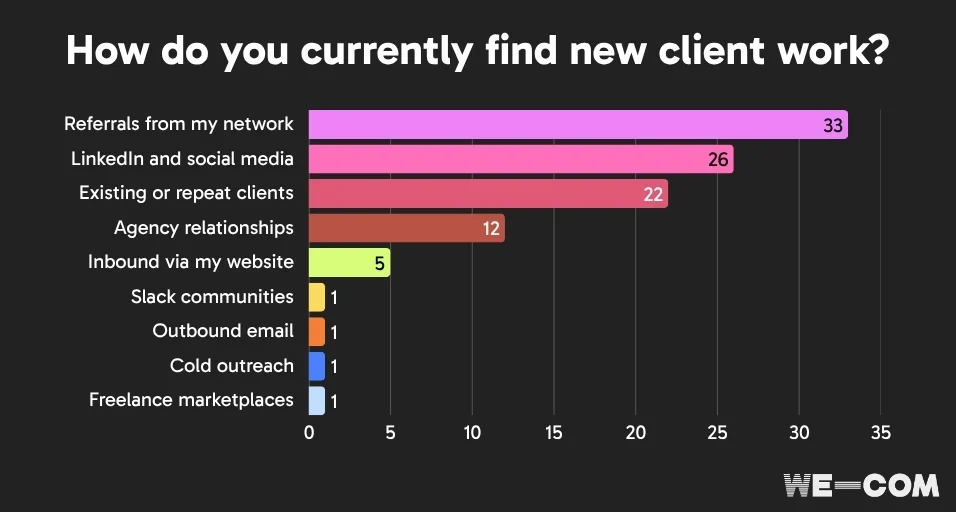
1. How do you currently find new work?
Referrals from their own network are how almost all freelancers find work (94%), while just 3% currently find work through a freelance platform.
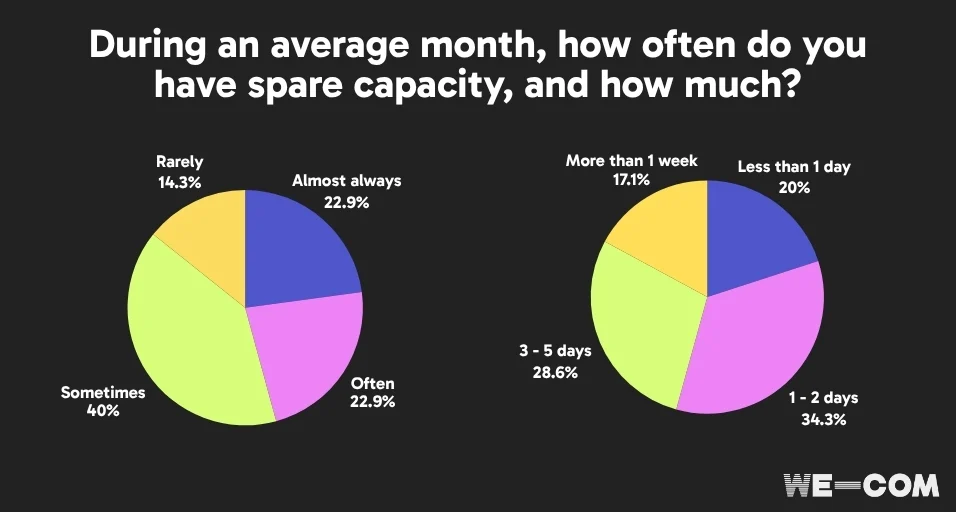
2. During an average month, how often do you have spare capacity, and how much?
86% of freelancers have spare capacity most months (Sometimes, Often, or Almost always combined), and only 14% say they rarely do.
The largest group (34%), has 1 to 2 days of spare capacity a month, and a combined 46% have three days or more.
3. What’s your biggest frustration or challenge with finding new work?
The top frustration is lead quality and market competition, cited by 31%, followed by prospects ghosting them entirely (23%).
- Lead Quality and Job Market Challenges (31%): Encountering poor-quality inbound leads, intense competition, vague job postings and LinkedIn callouts lacking clear details, and prospective clients offering unrealistic rates or lacking proper understanding of freelance value.
- Ghosting and Communication Issues (23%): Experiencing frequent unresponsiveness and ghosting from potential clients after initial meetings, proposal submissions, rate sharing, or even after the clients initiated contact.
- Time Constraints and Resource Management (20%): Finding enough time to balance outbound marketing, networking, and outreach while actively delivering work for existing clients, compounded by the lack of a dedicated business development team or support staff.
- Pipeline Predictability and Consistency (17%): Struggling with income fluctuations, the “feast and famine” cycle, and maintaining a steady, reliable flow of work without being overly dependent on referrals or facing sudden quiet periods.
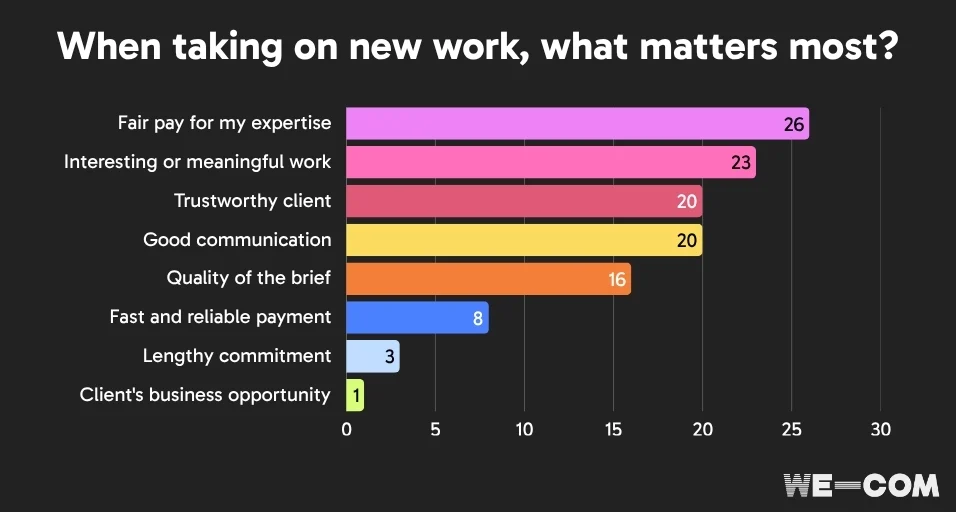
4. When taking on new work, what matters most to you?
Fair pay for their expertise is the top priority, chosen by 74%, ahead of interesting or meaningful work (66%) and a trustworthy client (57%).
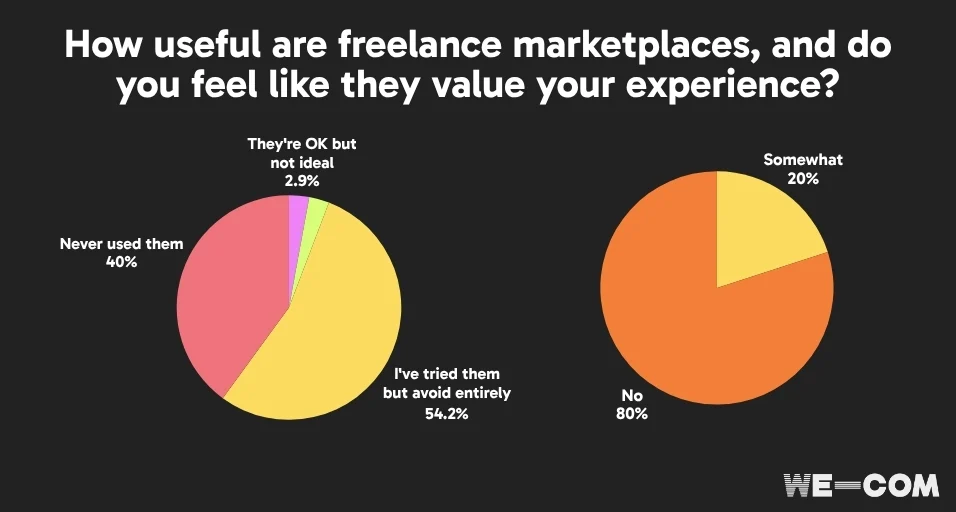
5. How useful are freelance marketplaces, and do you feel like they value your experience?
94% of freelancers are effectively opting out of marketplaces and platforms altogether, 54% have tried them and now avoid them entirely, and a further 40% have never used one at all.
80% of freelancers don’t feel that these platforms value their level of experience and expertise.
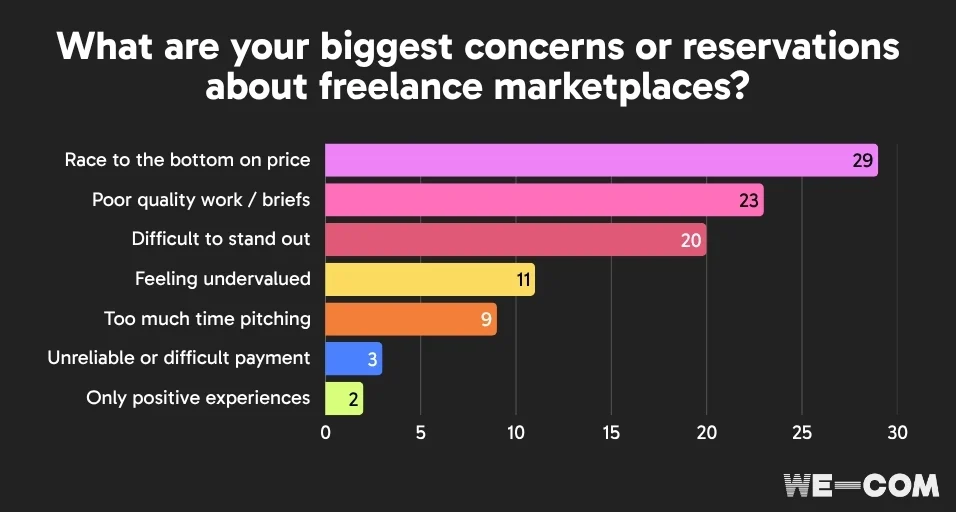
6. What are your biggest concerns or reservations about freelance platforms and marketplaces?
The dominant concern is a race to the bottom on price, cited by 83%, ahead of poor quality work or briefs (66%) and difficulty standing out from other freelancers (57%).
7. Do you have any general thoughts or views about these freelance platforms and marketplaces?
Price competition is the single biggest issue, raised by 31%, closely followed by freelancers simply avoiding platforms in favour of direct relationships (29%).
- Price and competition (31%): Marketplaces often lead to a “race to the bottom” where low pricing overrides expertise, forcing freelancers to compete with cheaper offshore options, automated tools, and other low-cost providers.
- Usage and alternatives (29%): Many experienced specialists tend to avoid these platforms entirely, relying instead on direct industry relationships or niche alternatives, while others view them as a risk for scams or poor communication.
- Platform dynamics and bias (14%): Building a viable profile demands significant effort, and platforms frequently favour internal ranking systems and reviews over external experience, creating a difficult barrier to entry for newcomers.
- Quality of work and clients (14%): Many platforms feature low pay, poor briefs, transactional relationships rather than genuine connections, and clients who do not adequately value specialised or strategic work.
8. Anything else you’d like to share about your experiences finding new work?
- Market Conditions: The current market is perceived as saturated, tough, and more difficult to navigate due to an increase in freelancers, AI impacts, and redundancies, leading clients to prioritise price over expertise.
- Networking and Referrals: Professional networks, word-of-mouth referrals, and 1:1 coffee meetings serve as the most reliable and effective sources for securing consistent work.
- Client Dynamics: Finding work is easier when it is not urgently needed, and clients often demand long payment terms or scattergun approaches that can be exhausting to manage.
If any of this sounds familiar, we’ve launched a marketplace alternative called ODD-JOBS to help.
It’s built for the one-off jobs e-commerce brands can’t get to. Businesses get a vetted specialist, a brief scoped by us and a fixed price agreed up front. Freelancers get what you told us matters most, fair pay, meaningful work and a trustworthy client, plus a brief scoped before you see it, and none of the race to the bottom this survey found.
Find out more about ODD-JOBS or apply to join the community.